A conversation with the author of Autocombustione dell’anima: isolation, the people who chose to intervene, rebuilding a life and a journey that restores connection and belonging.
Editorial note — This conversation has been adapted for reading from a transcript of the recording. Transcription errors have been corrected, fillers and repetitions removed, and interrupted or overlapping passages brought together. Some exchanges and digressions have been shortened or omitted. The text preserves the meaning and tone of the dialogue, but is not a word-for-word record. Opinions and personal experiences remain attributed to their speakers; ages, figures, plans and time references relate to the recording. This English version translates the edited Italian text, with some wordplay adapted.
What burns, and what is born
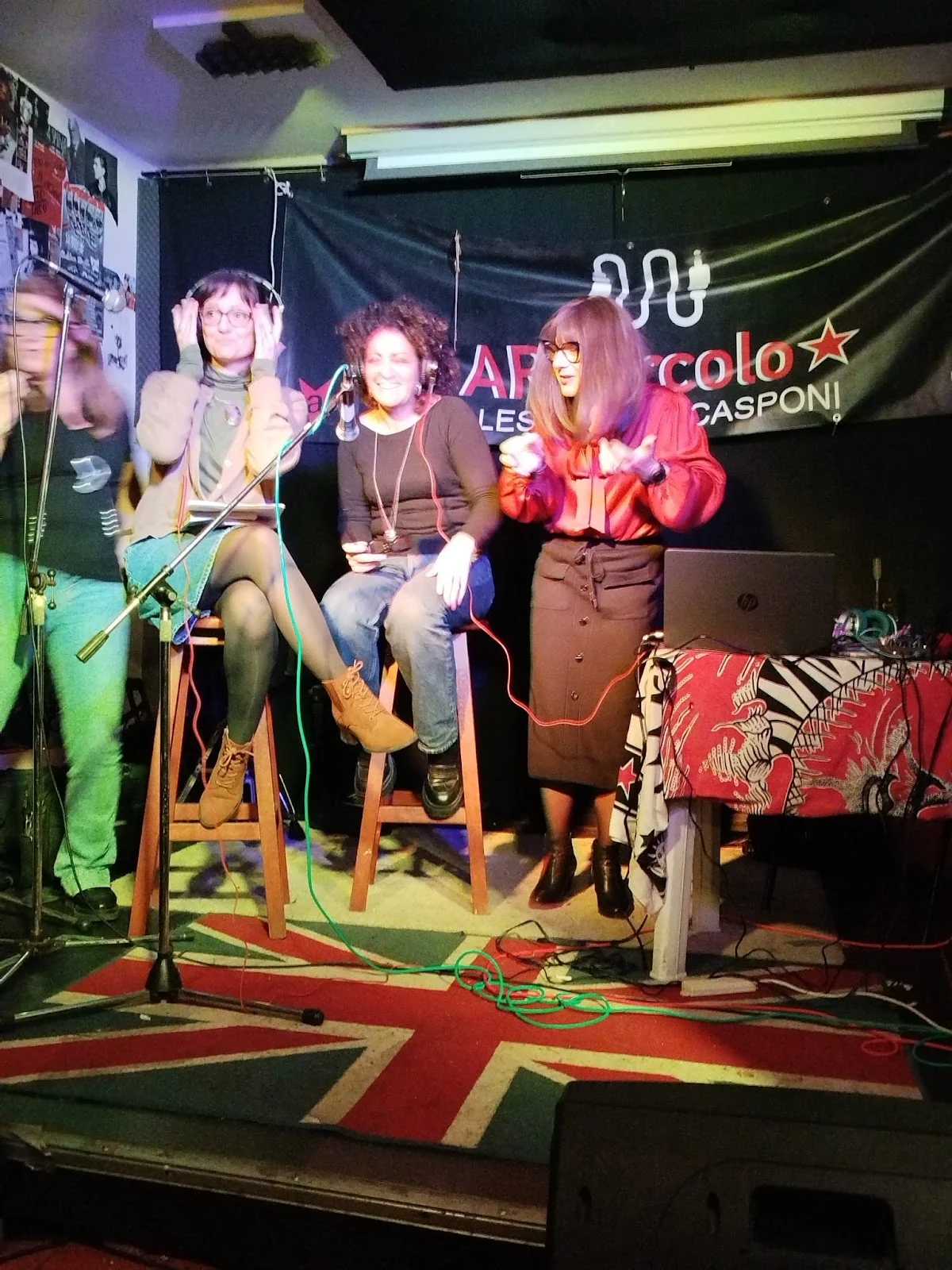
Diana: Today we have a guest in the studio: Antonella Gerbino, here to talk about her book. Welcome aboard our space station.
Antonella: Good evening, everyone, and thank you, Diana, for inviting me.
Diana: The title is positively incandescent: Autocombustione dell’anima, “Spontaneous Combustion of the Soul”. Why spontaneous combustion? What burns, and what is born?
Antonella: It’s the inner strength that helps me through difficult times. I don’t retreat into pain: I try to light the flame that brings me out of suffering. I feel it almost in my stomach, a visceral strength that lifts me up instead of trapping me.
Diana: We used to call books like this autobiographical; now there’s a much more fashionable word: memoir. Is it a memoir?
Antonella: Really, it’s above all a story of forgiveness and an investigation into my life, born out of a journey. I didn’t board a spaceship, but a plane, and found unexpected answers that helped me work through my past.
Diana: The rebirth you describe, the climb back up after falling, began with a terrible experience that remains very relevant: domestic violence.
Isolation and shame
Antonella: My family history was very difficult. As a minor I was placed with my grandmother because we suffered abuse at home. Even before that, my parents had isolated us from the world.
Diana: Isolation is abuse too. In our first episode we discussed how fundamental our need for social connection is.
Antonella: I looked for my place outside the family. I tried to keep that strength alive and be with friends, but I hid what I was experiencing. I felt ashamed and didn’t tell anyone what was really happening to me.
Diana: That’s one reason we’re here. During my own personal work in a psychotherapy group, two things struck me: how common these experiences were, and how little they were discussed. Thinking it only happened to us, pretending to be fine, we lose the opportunity to share and support one another with people who have similar experiences.
Antonella: When I look around in the street I think about how many people hide a reality that’s difficult to describe. As a girl I invented excuses and stories for my friends. Many friends, even longstanding ones, were shocked by the book: they hadn’t imagined that someone so cheerful, determined and sunny had that past.
I was even ashamed of my surname. That journey showed me where I came from and who my relatives were. Today I’m proud of that name.
The people who didn’t look away
Diana: Would you feel able to share some of your experiences, perhaps to encourage someone who hasn’t yet managed to get out?
Antonella: I only touch on them briefly in the book. I didn’t want a book of suffering, or to convey sadness: I wanted to describe the strength each of us can look for within ourselves.
My mother experienced a severe postpartum crisis, at a time when psychological support was different from today. As a child I was given responsibilities I shouldn’t have had: at six I went grocery shopping and missed school to run errands.
My classmates’ mothers saw me in the supermarket and wondered why I wasn’t at school if I wasn’t ill. They reported it, and my father had to send me back to school.
Diana: To a little girl, that’s reality: if Mum sends you to the supermarket, you go. You don’t yet have anything to compare it with.
Antonella: Exactly. Until you compare your life with girls your own age, you can’t know there’s anything else. The physical violence eventually reached the point where the Carabinieri intervened and took me away. I was sixteen and a half. I don’t describe every detail in the book: I don’t want it to be only an account of mistreatment.
Diana: We want to remind people who have experienced it, or are experiencing it, that they aren’t alone and can build a happy life.
Antonella: I dedicated a chapter to those mothers. I call the people I met who made a difference “angels”. They didn’t turn away: they broke through the wall of silence around me. Some became part of my family. I’ll thank them every day, because I owe them my life.
Help and protection
Diana: Would you talk about the support you received? Can the people intervening be trusted?
Antonella: In my experience the social workers were good. My story didn’t end up in the newspapers, and that matters: chasing sensational stories doesn’t respect certain feelings. Psychological support was still lacking, though. I followed a course of support; my younger brother didn’t continue his, and he still carries the consequences.
Diana: Finding the balance is difficult. When you meet a family, you see what emerges at that moment and hear what people tell you. If there’s something to hide, accounts may have been rehearsed.
Antonella: To hide the marks too: “I fell down the stairs”, “I bumped into the wardrobe”. Those marks are in my memory now. Finding the family I’d lost helped me work on forgiveness and look for answers: to understand where it had all begun.
Diana: When did you decide it would become a book?
Antonella: After returning from the journey. A treasure chest of unexpected things had opened. I understood my origins better and the mechanisms that had shaped my parents’ mentality. I was no longer alone in the world.
I was confined to bed with a physical problem and gathered the notes I’d kept in a drawer. I’d thought about writing before, but it was double-edged: it could be a release and terribly painful. During that enforced rest I wanted to create something beautiful.
“Liberating”
Diana: Your desire to reconnect with people keeps coming through: friends, support, good relationships. Like a blade of grass breaking through the pavement. When the police arrived, how did you experience that intervention? As an intrusion or a liberation? Of course, you don’t have to answer.
Antonella: Liberating. The Carabinieri came because my friends’ mothers had reported it. As I came down from the building I shouted at the neighbours: for years they’d shut their windows and blocked their ears. Everyone heard, everyone knew, but nobody spoke. People from outside had intervened, while they had done nothing.
Diana: I can see that scene in front of me, and it chills me. In a film, it would have the force of an explosion of liberation. But I’d like to give you room for what matters most to you: the climb back up. What happens next?
Antonella: I’m placed with the person who teaches me what love really is: my grandmother. She gives back the love I’d been denied. My parents had isolated themselves from everyone, taking her and my other relatives away from me too.
In her home I feel welcomed and loved. When my brother turns eighteen, we get a little home of our own and try to get back on our feet together. It’s still difficult for him: he didn’t receive the right psychological support.
Diana: I hope another way can be found to bring him closer to what he needs. I want to stress that it’s never too late. Sometimes a traumatic experience leaves us with a hard shell, sharp edges, habits that were the coat that saved us in the ice and snow. We shouldn’t hate ourselves for that coat. But then comes the extremely difficult moment of taking it off.
Antonella: Making yourself vulnerable is frightening, especially when you have a powerful, difficult story to tell.
The journey and the necklace
Diana: Tell us about that flight to Sicily.
Antonella: In 2018 my parents died six months apart. One of my father’s brothers found the courage to contact me and invited me to Sicily.
I expected a deserted village: that was how they’d described it to me, perhaps to stop me looking for other relatives, another way out. Instead I found a place full of affection, people who loved me. Last Christmas, at fifty-two, I celebrated with cousins and aunts and uncles for the first time.
One story moved many people. My grandmother had set aside a necklace for me and used to say, “This must go to Antonella”. Then the necklace became the subject of a conflict between my aunt and my father, and I was told my aunt had stolen it. I believed that version for years.
During the reunion with my father’s sister, after thirty-five years, at the end of a meal full of Sicily’s scents — fried aubergines, basil, tomatoes — she brought out a little red box with a golden ribbon. Inside was my grandmother’s necklace, promised to me thirty-five years earlier.
Diana: Objects make the whole journey and finally reach the heart.
Antonella: What was meant for me came back to me. A thousand things like that happened in four days. I returned with an immense amount to carry with me, which put me back at the centre of the world.
Diana: What always belonged to you, what they tried to take away and what returned to its rightful place, I think, is also your smile. You strike me as a wonderfully smiling person: whoever tried to take it away has lost.
Antonella: And they’ll never win against that.
Diana: Antonella Gerbino, Autocombustione dell’anima. Thank you for being with us.
Antonella: Thank you for this journey.








CommentiComments
Caricamento dei commenti…Loading comments…