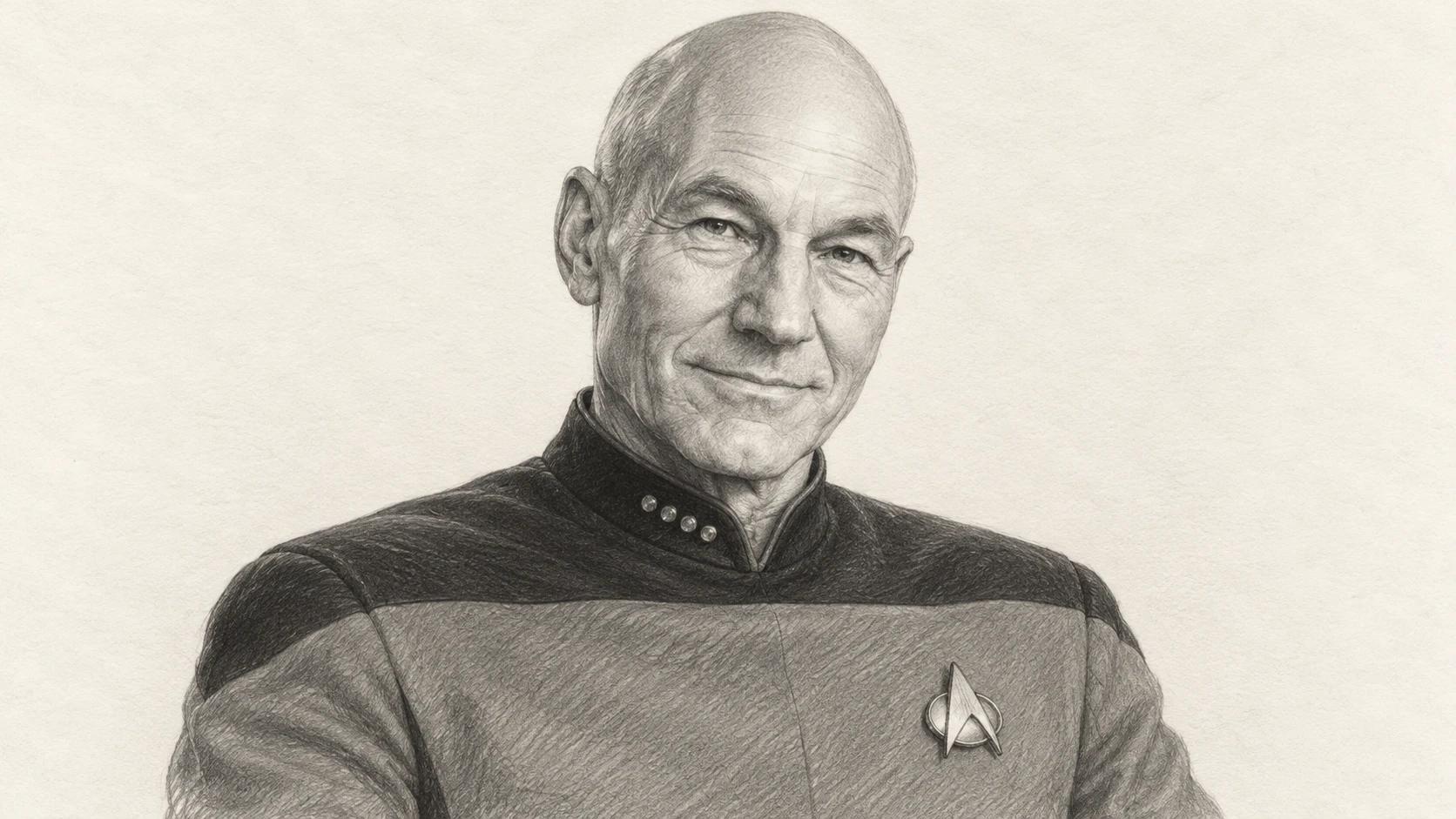
Today we say goodbye to Patrick Stewart. For those of us who, like me, feel a connection to Starfleet and its ideals, this grief feels like losing someone close. Jean-Luc Picard kept us company, made us think, and showed us an authority capable of listening. We followed his gaze towards unfamiliar worlds and recognised a place for ourselves in that future.
The bond between an actor and their character can become very strong for those watching. In Stewart’s case, learning about his life reveals that our trust had reasons beyond the screen. Our captain lent his voice to people who needed to be heard. He did so publicly, consistently, taking responsibility.
In his mother’s name
As a child, Patrick Stewart had watched his father beat his mother. He had learned to read the signs of an imminent attack, to recognise when shouting was about to turn into blows, and to try to step between them. A child studying an adult’s face to work out whether he will soon have to protect his mother is already living with violence.
He also spoke about the silence surrounding that home. The things adults said, the excuses, the idea that she must have done something to provoke him. As an adult, Stewart found the words to reject that complicity: his mother did not deserve what was happening to her. No provocation could ever have justified an assault.
Speaking about this experience was painful. He chose to do it because he knew that silence protects those who commit abuse. His fame allowed him to reach people who might never have attended a talk on the subject. Even a gathering of science fiction fans could become a place where someone finally recognised what they had experienced.
A door that could be locked
His relationship with Refuge, the British organisation supporting women and children escaping abuse, went back a long way. He recalled that, in the late 1970s, he and his wife took food, clothes and bed linen to the refuge in Chiswick. He became a patron in 2007. He used his public profile to raise funds, support services and speak to institutions.
In 2011, the University of Huddersfield, where he was Chancellor, announced that Julia Brooke had been awarded the Patrick Stewart / Refuge Scholarship. Her research concerned domestic violence experienced by pregnant teenagers. Lending his name to that work helped draw attention to the needs of young women whose voices were often overlooked, and to ways of supporting them.
His commitment continued over the years. As recently as 2024, Stewart supported Brick by Brick, a campaign by Refuge and The Independent to create a safe home for women trying to escape violence. A home, somewhere to start again: this, too, is what being an ally can mean.
Men must do their part
Stewart worked with Amnesty International against violence towards women. In 2009, he spoke about it at the launch of Created Equal, a book on women’s rights. On 8 March 2013, he took part in the launch of Ring the Bell, Breakthrough’s campaign asking one million men to make one million concrete commitments against violence.
The point was clear: men had to take responsibility for changing their own behaviour and challenging other men. Women could not keep being asked to solve the violence they were subjected to on their own. Those with a public voice also had a responsibility to set an example.
When he discovered more about his father’s history and wartime trauma, Stewart tried to understand it. He made clear that putting that behaviour in context did not mean excusing it. Recognising a man’s need for help could go hand in hand with holding him fully responsible for what he had done.
A woman in the audience
At Comicpalooza in Houston in 2013, Heather Skye spoke up to thank him. One of his speeches had helped her put a name to the abuse she had suffered. She asked what he was most proud of outside acting.
Stewart spoke about his work and his mother. He explained that he acted in her name: he had been unable to help her then, but now he could do something. Then he hugged Heather. That encounter shows the value of a testimony reaching someone who needs it. One person had spoken, and another had found words for her own experience.
Standing alongside Afghan women
In May 2012, Stewart signed an Amnesty International appeal to Barack Obama and Hamid Karzai. It called for Afghan women to have a voice in decisions about their country’s future and for their rights to be protected during the transition associated with the withdrawal of troops. Among the signatories was Gloria Steinem, one of the women featured in our Kattive Maestre series.
For us at Orbita Bassa, as we continue to follow these lives and listen to those working alongside them, this matters. Women had to take part in decisions affecting them. Their freedom deserved attention even when it risked being sacrificed to political convenience.
A friend to the queer community
Stewart described his support for gay rights as something natural. Theatre had brought him colleagues and friendships in which closeness needed no explanation. He shared campaigns and marches with Ian McKellen and spoke proudly about progress towards equal marriage.
Their friendship also gave us images of tenderness and freedom. Two famous men embracing and showing their affection in public. When a newspaper mistakenly described him as gay, Stewart said he had been flattered. There was no anxious need to distance himself from us.
After Elliot Page came out as trans in December 2020, he wrote publicly: “I am proud to be your friend.” A few words addressed to a particular person at a time when being visible also meant facing hatred and hostility. In 2022, speaking with journalist Dawn Ennis, he said he was willing to encourage LGBTQ+ representation in Star Trek.
His acting had also brought him into contact with queer lives. In Jeffrey, in 1995, he played Sterling, whose partner is living with HIV. In Match, he played the dance teacher Tobias. Desire, affection, fear and relationships found room in characters to whom he gave the same attention as the other human beings he brought to the stage and screen.
The captain we choose to remember
Stewart said he wished politicians would watch The Next Generation more often, pointing to Picard’s faith in negotiation. Talking, continuing to seek understanding, leaving a possibility open: we can recognise in that idea one of the reasons why this captain has remained so close to so many people.
We are preparing a special edition of Kattive Maestre dedicated to him. For once, we will be talking about a man: an ally who chose to use his voice to support women and the queer community. We want to explore how that choice is made, the actions it calls for, and what it can make possible in someone else’s life.
For now, this is our farewell. From one member of Starfleet to another, with today’s grief and gratitude for so many years of companionship.
I think of the five lead captains of the classic series: Kirk, Picard, Sisko, Janeway and Archer. Patrick Stewart is the first of the actors who played them to leave us. And so these are the words that come to me: I think this is the first time we have launched a captain of the Enterprise into space inside a torpedo.
Spock’s farewell in The Wrath of Khan comes back to me. Today, inside that torpedo we entrust to the stars, I imagine our captain. Excuse me, I’m crying.
Farewell, Captain, and thank you.
Diana Amaterasu
Orbita Bassa
Sources and further reading
The testimonies, interviews and documents used for the events described in this article.










CommentiComments
Caricamento dei commenti…Loading comments…