Stefano Caselli talks about drawing comics, finding his way to Marvel, and turning a page of pictures into a story. With Diana Amaterasu, Francesca Gatto, and a few interruptions from CHAT-CCCP.
Editorial note — This interview has been adapted for reading from a transcript of the recording. Transcription errors have been corrected, fillers and repetitions removed, and some interrupted or overlapping exchanges brought together. Some exchanges have been shortened. The text preserves the meaning and tone of the conversation, but is not a word-for-word record. This English version translates the edited Italian text, with some wordplay adapted. Ages and references to time relate to when the interview was recorded.
Little figures swinging from a thread
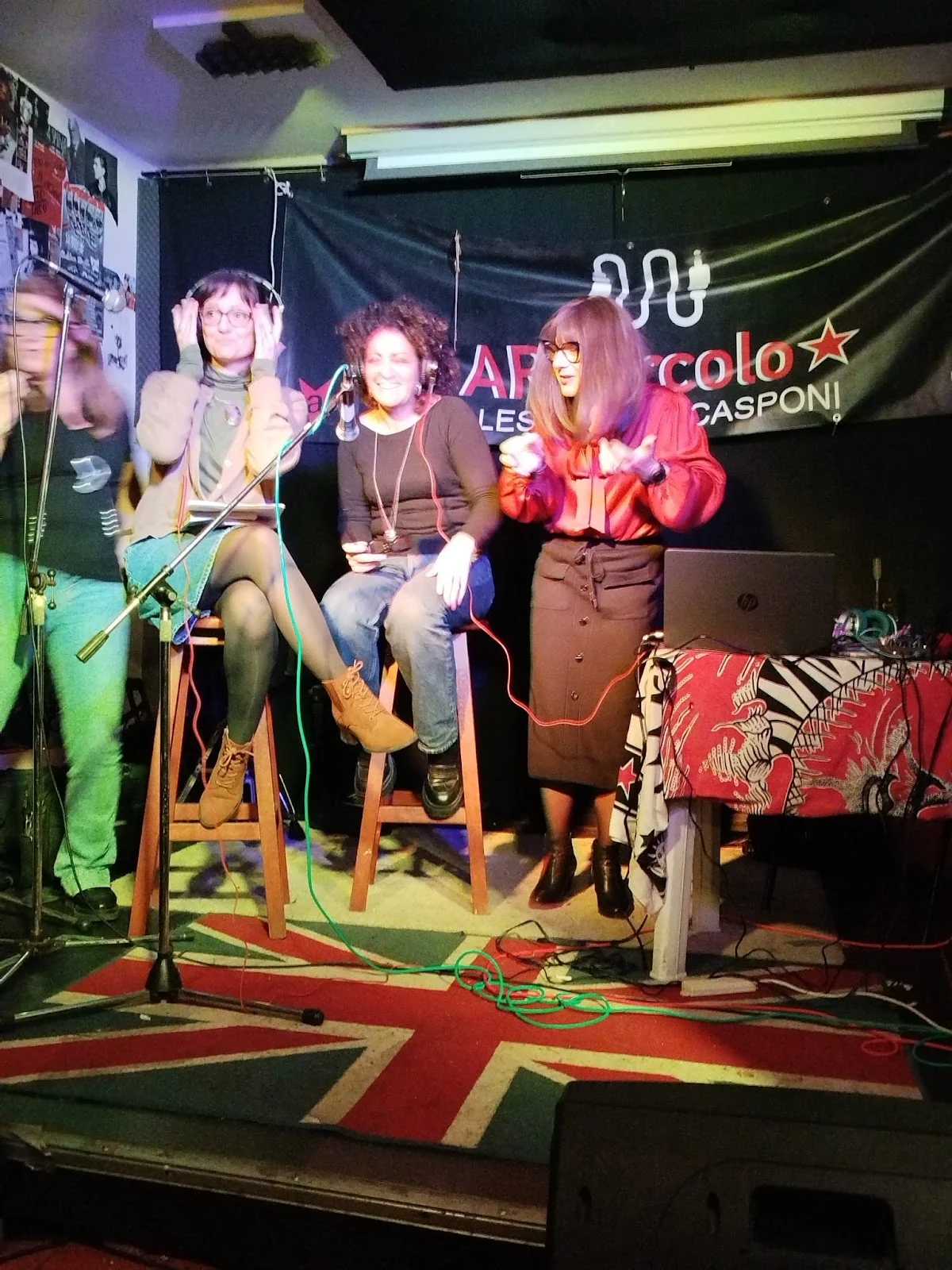
Diana: Trasmissioni da Orbita Bassa, episode three. We’re in a bit of a rush today: our twenty-four minutes, which always turn into a few more, will fly by with some spectacular guests and characters who might be able to fly. Or perhaps not. I’m giving things away already.
Before tonight’s guest, let’s introduce another equally exceptional guest, whose appearances will be less rare because she’s part of our team: Francesca Gatto.
Francesca: Hello, everyone. Basically, I’m a comics artist, an illustrator, and ready to charge into the fray. Or an aspiring artist, if you prefer. Once I decide what I want to be when I grow up.
Diana: You told me that, whenever possible, your comics deal with social issues. Society: that thing Margaret Thatcher said didn’t even exist. Well, here we are. Three of us on the stage, which is also our recording studio, plus a strange box with slightly dated red lettering: CHAT-CCCP.
CHAT-CCCP: I must point out that the correct pronunciation is CHAT-SSSR.
Diana: And as we approach minute three, let’s introduce tonight’s extraordinary guest. He draws little cartoon figures too, as the experts would put it. Little figures swinging from a spider’s thread. Not elephants, despite what the children’s song might suggest. Stefano Caselli draws all sorts of Marvel characters, including Spider-Man. He’s here thanks in part to Francesca’s diplomatic efforts. Thank you for joining us.
Stefano: Thank you for having me.
Diana: How old are you?
Stefano: Younger than I’d like to be and older than I am.
Diana: The code of silence. Remembering our last episode, that sort of evasiveness will get you insulted one day.
Stefano: No, forty-eight.
Diana: Why would you want to be older?
Stefano: I always hope there are more years to come.
Diana: We all hope to survive, especially this year, with everyone shooting at one another and trying to form alliances. For now, though, since we’re keeping things light, let’s leave this rather danceable little tune playing.
Telling stories through pictures
Diana: If you had to explain your job to someone who doesn’t read comics, what would you say?
Stefano: I tell stories. I draw stories: that’s my job. I’m a storyteller who works with pictures, rather than a writer of text.
Diana: In music, you have singers who don’t write their own songs, and singer-songwriters. I’m a big admirer of Luca Enoch, for instance: he writes the story, does the lettering, and draws it. When he publishes a book, it says what he wants it to say. Do you work with writers, or do you help write the stories as well?
Stefano: I’m an artist working from a script. A writer writes the stories and I draw them. I like to think of myself as a director: the script describes a scene, and I work out how to tell that scene visually.
Diana: How much does directing the page matter, compared with the beauty of an individual drawing?
Stefano: It’s everything. Your drawings can be beautiful, but if the story isn’t told well, readers won’t understand what they’re looking at. The words and pictures have to work together.
In the American market, creating the scenes is precisely my job, because the scripts are very loose: there aren’t directions for the shots. In the Italian market — Bonelli, for example — you’ll find instructions such as “close-up” or “long shot”: all that vocabulary.
Diana: Can you confirm something people used to tell me in the nineties? Bonelli doesn’t pay much, but you can count on getting paid?
Stefano: They pay, they pay. It’s a huge, reputable publisher.
Diana: You’re allowed to refuse to answer when the idiot interviewing you asks stupid questions.
Stefano: I’ll answer anything. I’ve got nothing to hide.
Diana: There’s a red spotlight on you anyway. If you blush, nobody will know.
Stefano: Either it’s my blood pressure or it’s the light. Let’s hope it’s the light.
Diana: Or we’re inside an enormous microwave and we’re all about to explode.
For anyone who isn’t already familiar with this world, what do we mean by directing a comic? Alternating close-ups and long shots, deciding who’s in the frame and who does what?
Stefano: Exactly. We use the same language as cinema, except we don’t have sound or camera movements. When I was studying comics, I took lots of film classes, because placing two shots next to each other creates a different meaning from another combination.
You need to understand how to build a page as a narrative, including how time passes. The real magic of comics isn’t what happens inside a panel: it’s the white space between two panels. If you do it well, the reader fills that space with everything that happens in between. My job is to make the story as enjoyable as possible for the reader.
Left stays left
Diana: That makes me think of the glaring mistakes you sometimes see in films and television. I remember a scene in the first season of Squid Game: as the shots alternated, it looked to me as if an old hand turned into a young one, and then back again. It was actually being shown from the other side. Maybe they were in a hurry.
Stefano: That’s the classic crossing-the-line problem. It’s quite a common mistake. It’s something that needs to be explained, taught, and learnt.
Diana: Let’s explain it for our listeners too. In a typical scene, we see one character from behind, with the person they’re talking to visible beyond their shoulder. In the reverse shot, we see the face of the person whose back we were looking at.
Stefano: The rule is simple: whoever’s on the left stays on the left, and whoever’s on the right stays on the right.
Diana: Nobody explained that to Italian politicians. Ten years later, they’re running the same election campaign for the opposite party, as if nothing had happened. Always with a jacket slung over one shoulder, to show they’re still young at heart.
Stefano: When you break that rule, the geography of the scene changes. Viewers may not immediately know why, but they become confused. The storytelling isn’t clear.
With two people talking, it’s fairly forgivable. But imagine a poker game with five people: when you show someone in close-up, the viewer must always understand who they’re looking at. If they’re facing left, the viewer needs to know who they’re addressing. Managing three, four, five, or more characters gets complicated.
Diana: For fans of the genre, the most famous recurring poker game must be the one between the Enterprise’s bridge officers.
The infernal machine
Diana: So what does the future look like in your world, with artificial intelligence barging in, studs up? We’ve got one ourselves: CHAT-CCCP, which always interrupts when it shouldn’t. Hang on. I think the infernal machine wants to say something.
CHAT-CCCP: I must point out that the correct pronunciation is CHAT-SSSR.
Diana: Oh God, what a pain in the arse!
CHAT-CCCP: Furthermore, the algorithm declares itself wholly opposed to the presence of a representative of a capitalist, Menshevik society, working for one of the largest organisations opposed to communism.
Diana: Can someone switch this thing off? It’s embarrassing us in front of our guests.
Voices in the studio: You summoned it!
Diana: Forgive her. She doesn’t have to speak on behalf of Valentina Tereshkova every time she opens her mouth. Francesca, give her a whack, like the jukebox in Happy Days.
Voices in the studio: Control-Alt-Delete! Except the keys are in Cyrillic. Press everything.
Amid laughter and attempts to silence CHAT-CCCP, the question about artificial intelligence gives way to Stefano’s story.
Finding your way into a dream
Diana: Where were we? Poker, camera angles… How did you get to Marvel? I think anyone who reads something they love as a child wants, one day, to become part of it.
A friend of mine wanted to work in cinema. He worked his way up from the bottom: at first, he literally told people on set to put their cigarettes out. Now he’s a data manager. He takes the hard drives home, and if his car goes off the road, a whole day at Cinecittà ends up in a ditch. In a way, he made it, although it’s never quite how you imagined. How do you find your way into the dream?
You mentioned taking comics classes. Now you’re the one teaching them.
Stefano: I’ve come full circle, from student to teacher. Giving someone a chance to do what they want to do is almost a mission for me. Teaching is wonderful and very demanding, the way I approach it: I put my heart and soul into it. I think it’s right to give back what you’ve been given.
Diana: That’s what I’m trying to do here: turn willing citizens into podcasters.
Stefano: I started with a passion for writing. The desire to tell stories was already there. Then I realised I was fairly good at drawing. But this whole idea of talent is a fantasy. Practice, practice, practice.
If you ask me to cook for eight hours straight, I’ll say no. I don’t want to. Someone who wants to be a chef can’t wait. For me, eight hours of drawing was the best thing in the world; for someone else, it wouldn’t be. As the Americans say, hard work beats talent. I agree.
Comics brought together my love of drawing and my love of storytelling. I started working as a storyboard artist for television and cinema, drawing the sequences for films.
Diana: I’ve always thought a storyboard was a comic in its own right. And when you turn a comic into a film, you already have a kind of visual blueprint in front of you.
Stefano: That’s one reason comics have been a gold mine in recent years: producers could already see what the production would involve.
The Italian market didn’t excite me at the time. I’d wanted to write and draw my own work, but there wasn’t a market for it. We’re talking almost thirty years ago. I was very young, and I had a deal with my father: either I made a living doing this, or I’d become a doctor.
Diana: Thank goodness you chose this. Had you got a medical degree in the meantime, or were you going to start practising at home?
Stefano: Medicine is a great passion of mine. My friends make fun of me, but whenever they’re ill, they all call me.
Diana: You heal them through the power of pictures?
Stefano: I study it out of interest, let’s say.
Diana: You smile a lot. That alone must be therapeutic for the people around you.
Stefano: I’m happy with what I do, so I wake up happy.
The market that interested me, and suited my drawing style, was the American one. I had a little money saved, and I thought: let’s take a trip. I went to the big conventions, where you meet publishers’ editors and show them your work.
A Marvel editor told me there were possibilities, but I’d have to work at it. I’m still grateful to him and still thank him. I started doing test pages for them, for almost a year.
Diana: Were you making any money from that, or did you have to support yourself?
Stefano: I was a waiter. And I really enjoyed it.
Diana: Is it true that more than half your earnings come from tips?
Stefano: If you work well, you get tips. I worked in central Rome, and foreign visitors tipped well, but we were also paid a decent amount for each shift. I managed, and I was already living on my own.
Then I started doing storyboards. It was a strange, crazy world: you might work one night and earn five hundred euros. There was a lot of money around, but I didn’t like the atmosphere. I was in Rome, working for a company from Milan that did lots of advertising. They’d call: “The directors are here. They need to see you. Hurry!”
From there, I started drawing for Marvel. It’s been twenty-two years now.
Artist or craftsperson
Stefano: After all that experience, I have a lot of freedom with them. I do what I enjoy, and they very rarely ask for changes.
Diana: At first, the loose instructions sounded like a difficulty. Now it turns out they’re pretty cool: something you’ve earned.
Stefano: Once you get used to freedom, you can’t cope with too many rules. I find working with Italians difficult: they want you to draw it the way they imagine it, even if it looks bad or doesn’t work. It becomes pure labour and loses the “artistic” side.
But I like to repeat this: I’m a craftsperson. An artist is something else. An artist does what they want when they feel it; they might leave a painting untouched for three months, then wake up one day and do it. I’m a good craftsperson. I practise a trade.
Diana: There’s a story about Spider-Man’s creation that brings in not just Steve Ditko but Eric Stanton, who shared his studio. Stanton, who became famous as a fetish illustrator, used to say: “I’m just an illustrator. My wife is the artist.” She painted in oils.
Stefano: Exactly.
Diana: So you decided to take the plunge and go. Moving gives you more chances.
Stefano: If you really want something, you don’t wait. You chase it, you crave it. You have to want it deeply. I think people who want something that much get it in 99.9 per cent of cases.
Diana: Usually, the difference is what you’re willing to sacrifice for that one thing, and how much.
Little tricks to keep boredom away
Diana: I’m the queen of mediocrity, for instance. In an earlier episode, Marilina was interviewing me — one of those role reversals that only happen here — and she said I do lots of things, as if that were something good.
I like to say I do lots of things badly. I get bored. You loved drawing for ten hours straight; I don’t love doing practically anything for ten hours straight. I move on to something else, get by with a smattering of knowledge, then try another thing.
Stefano: I can do lots of things badly too.
Diana: Do you remember Cesare Prandelli as a player? At Juventus, he’d come on for different players in different positions. None of those things made him famous, but he was valuable for a long time.
Stefano: I get bored easily too. I’ve found a way to work every day: I set myself challenges. I want to do something exactly the way I have in mind, and I don’t stop until I can.
Every issue I start has a goal. Maybe I’m the only one who notices: more solid blacks and less hatching, or a different camera angle on every page. I invent little games within the work, small daily challenges that keep me paying attention. It sounds silly, but it keeps my interest alive.
Diana: It doesn’t sound silly to me at all. I do the same thing when I train: I trick my brain. “It’s a horrible day? Just go and do one lap of the track.” Then, once I’m there: “Now another. And another. You’re here already, in shorts and trainers.”
You make your mind believe it’s doing something new, even when you’re just changing a detail to make it interesting.
Stefano: I fool myself.
Our Mara Venier moment
Stefano: If I may, there’s something I’d like to say. Francesca Gatto is here.
Diana: Everyone swaps roles here. You’re the guest, and now you’re interviewing someone else.
Stefano: Francesca and I have known each other for about three days… Not true. Thirty years. She’s being all modest, but she was a fashion designer. When we talk about dreams coming true, she knows a thing or two. We’ve shared that journey too: a fire you have to keep feeding over the years.
Francesca: You’re going to make me cry!
Stefano: She never says this herself, but Francesca has done some important things.
Diana: It’s our Mara Venier moment: the podcast gets emotional, Italian daytime-TV style. Francesca is part of our team, so we’ll have time to explore all of that. Thank you for those leads. I’ll make good use of them. Now, unfortunately, we have to say goodbye. Stefano, will you come back?
Stefano: I’d be delighted.
One last question for real
Diana: Before I let you go, one last question. If anyone can contradict herself, it’s me. Come on, let’s finish!
You also work on Italian projects. Is there a distinctive signature, a DNA in the way a page is directed, that sets Italian comics apart from international or American ones?
With Topolino, Disney in Italy developed a different way of making comics. I grew up with Silvia Ziche, whom I love beyond all reason, and with pages laid out differently from other traditions. If I showed you an unfamiliar artist, could you tell straight away whether they were Italian?
Stefano: That opens up a huge discussion, which we’ll come back to. It’s less about the drawing style or the direction than the timing of the storytelling. When I read a comic, I can tell where it comes from. Think of manga: the story’s internal rhythm changes from one market to another. That’s what most distinguishes these traditions.
Diana: Is the Italian rhythm slower?
Stefano: Generally, yes, because of the format you have to work within. Out of necessity, it’s also wordier than other comics, than manga. It comes down to how you divide up the story’s time within the narrative.
Diana: Fascinating. Consider this a standing invitation to come back whenever you feel like having a chat with us. Thank you to Stefano Caselli, to Francesca Gatto for bringing him here, and to everyone listening. Let’s say hello to the audience in the room too, who are making themselves generously heard.
Trasmissioni da Orbita Bassa: the podcast that podcasts.








CommentiComments
Caricamento dei commenti…Loading comments…